Rosemont’s live music options typically mean cover bands at sports bars competing with television noise, acoustic guitarists providing background ambiance at restaurants, or hotel lounge performers playing to nearly empty rooms. These venues treat live music as decoration rather than entertainment—something happening in the background while you eat and drink.
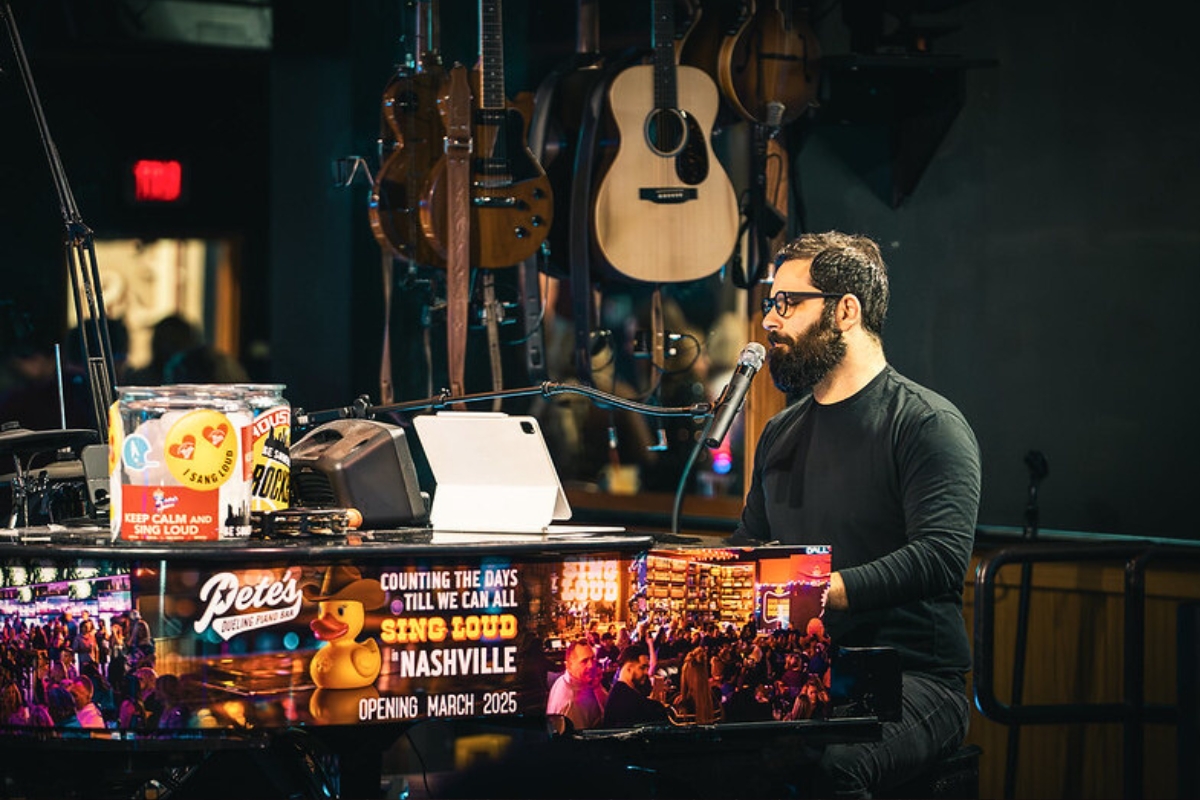
Pete’s Dueling Piano Bar delivers interactive live music where audience participation drives the entire show. Two pianists take requests written on napkins with tip money attached, performing whatever the crowd demands rather than working through predetermined setlists nobody asked to hear.
Rosemont’s location at the convergence of I-90, I-190, and I-294 makes Pete’s more accessible than downtown Chicago venues requiring Loop navigation, expensive parking, and CTA transfers. The entertainment district setup around MB Financial Park lets you handle dinner and live music within walking distance, consolidating your entire evening into one area.
Rosemont’s Live Music Scene Beats Downtown Chicago for Accessibility
Downtown Chicago live music venues force you to navigate Loop traffic during evening rush hours, hunt for street parking that doesn’t exist, or pay $40-50 for garage parking several blocks from your destination. Arriving at a 7pm show from the suburbs means leaving by 5:30pm to account for Kennedy Expressway gridlock and parking nightmares.
CTA access to downtown venues requires multiple train transfers for most suburban riders, adding 60-90 minutes each direction to your evening. You’re coordinating schedules around the last trains home or accepting surge-priced ride-shares that cost $50-80 from River North back to northwest suburbs.
Pete’s sits directly off I-190 near O’Hare Airport with immediate access from I-90 and I-294, eliminating downtown traffic complications entirely. Drivers from northwest suburbs take I-90 east to I-190, drivers from western suburbs use I-290 to I-90, and drivers from northern areas follow I-294 south—all routes converge at Rosemont without Loop navigation.
The Blue Line runs directly from downtown to Rosemont station for city residents who prefer transit, offering a single-train 30-minute ride with frequent service during evening hours. You’re not transferring between Red Line and Brown Line or walking six blocks from the nearest station in February cold—you exit at Rosemont and walk to Pete’s.
Parking at Pete’s and surrounding Rosemont entertainment district costs substantially less than downtown garages, with some lots offering free evening parking. You’re saving $40+ per visit compared to Loop parking fees while avoiding the stress of circling blocks looking for available spaces or walking through unfamiliar neighborhoods after dark.
The Problem with Most “Live Music” Venues in Rosemont
Rosemont’s existing live music venues follow predictable formats that treat musicians as background noise rather than main attractions. Sports bars book cover bands playing classic rock medleys while patrons focus on television screens showing Bulls or Blackhawks games, forcing musicians to compete with sports commentary and crowd reactions to plays.
The bands perform competently enough, running through “Sweet Home Alabama” and “Brown Eyed Girl” for the hundredth time, but nobody came specifically to hear them. You’re there for drinks and game-watching while live music provides ambient sound between commercial breaks, creating awkward dynamics where musicians play to audiences who aren’t listening.
Restaurants offering live music typically mean one acoustic guitarist positioned near the bar playing dinner background music at volumes low enough to not interfere with table conversations. The setup works fine for creating atmosphere during meals, but it’s passive entertainment where the musician might as well be a Spotify playlist.
Hotel lounges around O’Hare book jazz trios or piano players performing standards to rooms that stay half-empty most nights. Business travelers nursing drinks after long flights offer polite applause between songs, but the energy stays flat because nobody’s genuinely invested in the music or connecting with performers.
These venues treat live music as something happening in the corner that you acknowledge briefly before returning to your actual reason for being there. The musicians earn their paychecks performing songs nobody requested to audiences who won’t remember the performance by morning.
Pete’s Dueling Piano Bar operates on the opposite premise—live music becomes the entire point of showing up rather than background ambiance to ignore. The interactive request-based format makes audience participation mandatory rather than optional, creating entertainment where you actively shape the show through song choices and tip money.
How Dueling Pianos Actually Work (And Why It’s Better Than Standard Live Music)
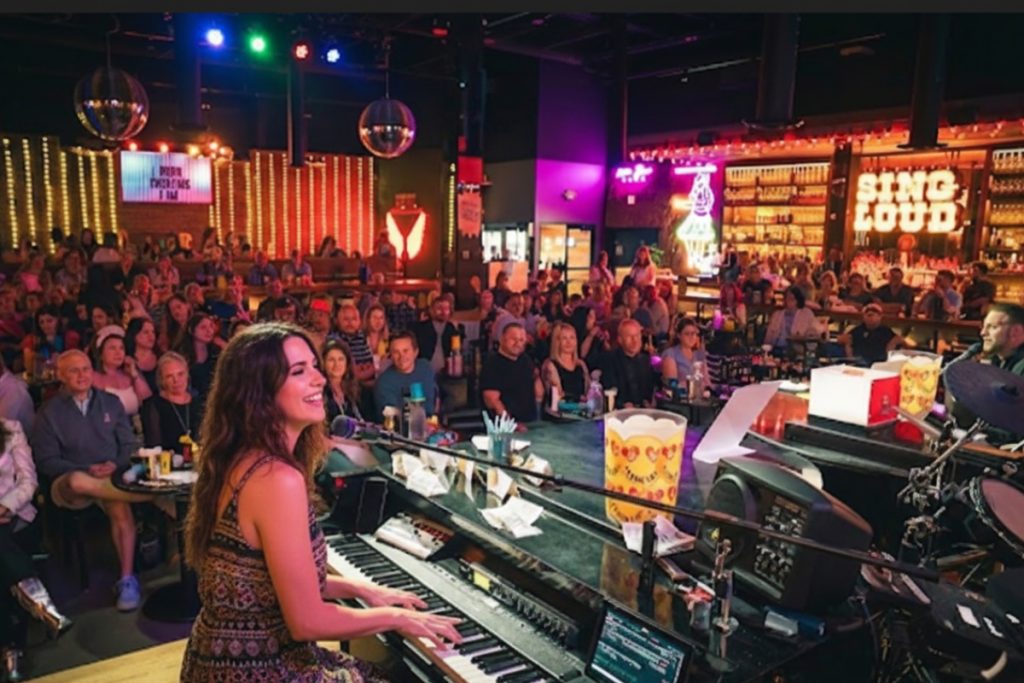
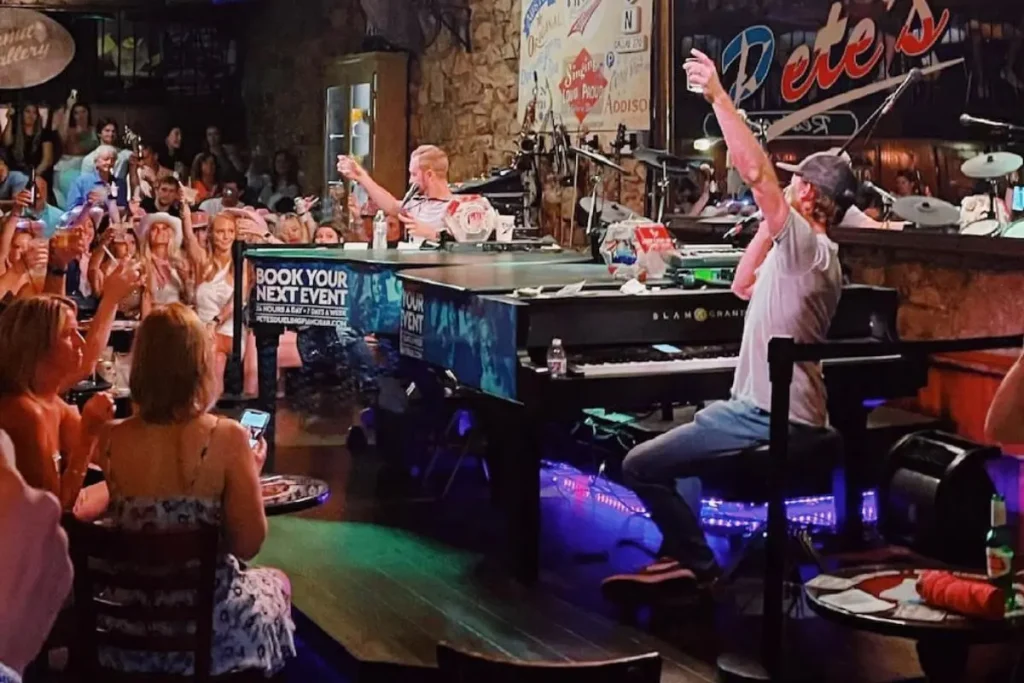
Two grand pianos face each other on stage with talented pianists positioned to make eye contact while competing for audience attention and tip money. The show runs entirely on audience requests written on napkins with cash attached—you write down your song choice, add tip money based on how urgently you want to hear it, and hand it to the pianists.
The more you tip, the faster your song gets played, creating friendly competition between tables and groups trying to out-tip each other for priority placement. If someone tips $20 for “Piano Man,” but your table drops $30 for “Bohemian Rhapsody,” the pianists acknowledge the economic priority and adjust the queue accordingly.
This request-based system means every show at Pete’s develops differently based on who shows up and what they want to hear. A Friday night crowd dominated by corporate groups might lean heavy on ’80s rock and classic singalongs, while Saturday nights with younger crowds could swing toward contemporary hits and guilty pleasure pop songs.
The pianists don’t just perform requested songs mechanically—they banter with each other between numbers, create comedy bits roasting audience members good-naturedly, and negotiate in real-time when someone requests songs they don’t want to play. If one pianist hates a particular request, the other pianist might defend it while the audience weighs in.
When popular crowd-pleasers like “Don’t Stop Believin'” or “Livin’ on a Prayer” get requested, the whole room participates whether people initially planned to sing or not. The energy feeds on itself as the night progresses and audiences get more comfortable being loud, enthusiastic, and terrible at group singing.
The format works because the pianists carry the musical heavy lifting while making audiences feel like active participants rather than passive observers. You don’t need musical knowledge, performance ability, or confidence to enjoy Pete’s—the setup naturally encourages participation through the simple act of writing song titles on napkins and tipping for priority placement.
Why Music Venues With “Something For Everyone” Deliver Nothing For Anyone
Entertainment venues advertising “something for everyone” typically rotate between music genres throughout the evening, playing thirty minutes of rock followed by pop followed by country in attempts to satisfy diverse crowds. The approach leads to everyone tolerating music they don’t care about while waiting for their preferred genre to cycle back around.
Sports bars with house DJs curate playlists designed to offend nobody, which means satisfying nobody—generic Top 40 hits mixed with classic rock radio staples played at volumes loud enough to create atmosphere but not loud enough to interfere with televised games. You’re getting algorithmic background music, rather than something chosen by the people in the room.
Jukebox bars let patrons select songs through touchscreen interfaces, but the system stays inherently passive. Someone plays three country songs in a row, another person queues up heavy metal, and the room receives whiplash from jarring transitions between genres that don’t flow together naturally. The music happens to you rather than with you.
Multi-genre venues trying to accommodate every taste simultaneously end up diluting the experience for everyone. The rock fans tolerate the hip-hop sets, the country music lovers endure the EDM blocks, and everyone spends portions of their evening wishing the music would shift to something they actually wanted to hear.
What Sets Pete’s Apart
The pianists at Pete’s respond to whatever requests come in, so the room’s preferences determine the musical direction naturally. If classic rock dominates the requests, that’s what gets played. If someone tips heavily for contemporary pop and the crowd responds enthusiastically, the show shifts in that direction.
The request system accommodates diverse musical preferences within single evenings without forcing anyone to sit through extended blocks of genres they hate. Your friend who loves ’80s hair metal can request “Pour Some Sugar on Me,” your coworker obsessed with current Top 40 gets “Espresso,” and the pianists weave these requests together.
Unlike jukeboxes where songs play regardless of room energy, the pianists at Pete’s read the crowd and adjust performances accordingly. If a slow ballad request kills momentum, they might speed through it or add comedy elements to maintain engagement. When high-energy crowd-pleasers get requested, they lean into extended versions that encourage singalongs.
The format works because live performers adapt to feedback in real-time rather than following algorithms or predetermined playlists. You’re not stuck with whatever the venue scheduled or whatever the DJ felt like playing—the entertainment responds directly to the room through the economic voting system of tipped requests and crowd reactions.
The Hidden Costs of “Cheap” Live Music Nights Around Rosemont
Rosemont bars and restaurants advertising “free live music” or “no cover charge” offset the cost of booking musicians through mandatory drink minimums, inflated drink prices, and policy requirements buried in fine print. You’re not paying entrance fees, but you’re paying premium rates for watered-down well drinks while being told you must order at least two beverages.
The “two-drink minimum” standard at many live music venues means you’re spending $24-32 on cocktails before considering food, tips, or additional rounds. Sports bars with free live music compensate by charging restaurant prices for basic bar food—$16 for nachos, $14 for wings, $12 for burgers that would cost $8-10 at establishments without entertainment.
Concert venues in Chicago charge $80-150 for tickets through Ticketmaster, which adds “service fees” and “facility fees” totaling another $20-35 per ticket. You’re spending $100+ before entering the venue, then paying $14-16 for domestic beers and $18-22 for basic cocktails once inside. An evening at a standard concert venue easily hits $150-200 per person.
Pete’s Dueling Piano Bar operates with transparent pricing—no cover charges, no drink minimums, no hidden entertainment fees added to tabs. You’re paying standard bar prices for drinks, typically $8-12 for cocktails and $6-8 for beers, which falls in line with normal Rosemont entertainment district pricing rather than premium venue markups.
The song request tips stay completely optional based on how badly you want to hear specific songs and how quickly you want priority placement. Tipping $5 gets your request into the queue eventually, tipping $20 moves it toward the front, and tipping nothing means you enjoy whatever others requested without participating in the selection process.
Skip the overpriced concert tickets and hidden drink minimums. Head to Pete’s Dueling Piano Bar at 5510 Park Place where you’ll actually know what you’re spending before your card gets charged. Request the songs you want to hear, stay as long as you’re having fun, and leave without discovering surprise fees on your final tab.
Frequently Asked Questions
What type of music do the pianists play at Pete’s?
The pianists play whatever the audience requests—classic rock, contemporary pop, ’80s throwbacks, country, guilty pleasure songs, whatever the crowd tips to hear. Every show develops differently based on who shows up and what they request.
How much does a night at Pete’s Dueling Piano Bar cost?
You’ll spend $8-12 for cocktails and $6-8 for beers at standard bar prices, plus optional $5-20 tips per song request. Total cost runs $30-50 per person for several hours, substantially less than $150-200+ for Chicago concert venues.
Do we need tickets or reservations in advance?
Pete’s operates on a walk-in basis for general admission rather than requiring advance ticket purchases. However, calling ahead is recommended for weekend evenings when crowds pack the venue, or if you’re planning to bring a larger group. Private event bookings for parties and corporate gatherings require advance arrangements.
How do we request songs at Pete’s?
Write your song request on a napkin, attach tip money based on how urgently you want to hear it, and hand it to one of the pianists. The more you tip, the faster your song gets played. Tipping $5 gets your request into the queue, while $20+ moves it toward priority placement. You can also enjoy the show without requesting anything and let others choose the music.
Can we book Pete’s for private events?
Yes, Pete’s accommodates private event bookings for birthday parties, bachelor/bachelorette celebrations, corporate gatherings, and group events. Contact the venue directly at 5510 Park Place in Rosemont to discuss capacity, availability, and package options for your specific event size and needs.
What’s the best way to get to Pete’s in Rosemont?
If driving, take I-90 west to I-190 toward O’Hare, then exit at the Rosemont entertainment district. Pete’s sits at 5510 Park Place with accessible parking nearby. From downtown Chicago, the CTA Blue Line runs directly to Rosemont station, approximately a 30-minute ride with frequent trains during evening hours.
Is Pete’s appropriate for all ages?
Pete’s operates primarily as a bar environment with age restrictions, though earlier show times may accommodate mixed-age groups depending on crowd size and show content. Call ahead to confirm specific show times and age policies if planning to bring family members or groups with varying ages.
What time do shows start at Pete’s?
Show times vary by day of the week and season, with typical evening performances starting between 7pm-9pm. Contact Pete’s directly or check their current schedule to confirm exact show times for the night you’re planning to visit, especially during peak weekend periods when multiple shows may run.